
CAR-T for Acute Myeloid Leukemia
CAR-T therapy for acute myeloid leukemia is still a clinical-trial approach, not FDA-approved standard care. AML gets attention in cell-therapy research because relapsed or refractory disease can be hard to treat, but AML has been much more difficult for CAR-T than B-cell cancers.
One major reason is target selection. Many AML targets are also present on normal blood-forming cells, so a treatment strong enough to attack leukemia may also damage healthy marrow. Reviews published in 2025 and 2026 repeatedly highlight CD33, CD123, and CLL-1 as key AML targets under study, while also warning about on-target myeloid toxicity and limited durability.
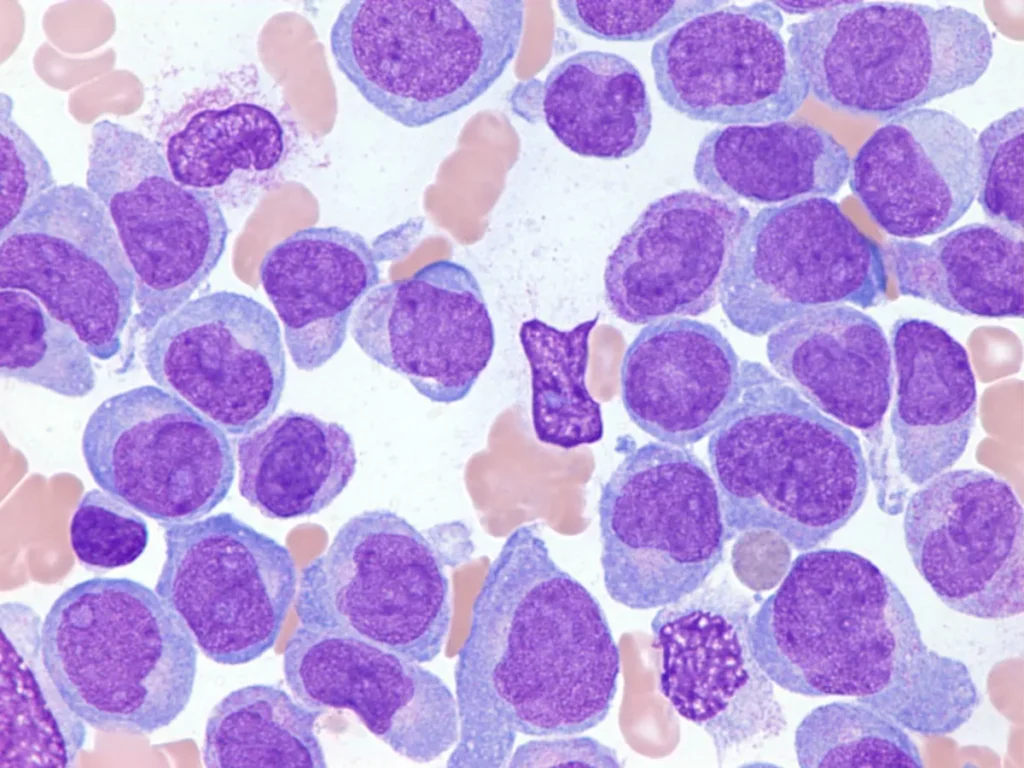
Why AML Is Hard for CAR-T
AML is hard for CAR-T because there is no perfect only target. In B-cell cancers, targets like CD19 are much cleaner. commonly studied antigens such as CD33 and CD123 can also appear on normal hematopoietic stem and progenitor cells, which raises the risk of prolonged marrow suppression. AML also has antigen heterogeneity and an immunosuppressive microenvironment that can weaken CAR-T activity.
Another problem is durability. Early AML CAR-T studies have shown some responses, but responses are often inconsistent and may not last long without additional consolidation strategies such as transplant.
What CD33 and CD123 mean
CD33 and CD123 are proteins found on many AML cells, which is why they are attractive CAR-T targets. The problem is that they are not exclusive to leukemia cells, so targeting them may also affect normal myeloid development and marrow recovery
CAR-T trials for AML are usually most relevant for patients with relapsed or refractory AML, including some patients after prior transplant relapse.
Trial screening usually looks at relapse setting, prior transplant status, disease burden, organ function, performance status, and trial-specific inclusion or exclusion rules.

Who Might Consider a Trial
AML CAR-T trials are typically most relevant for patients with relapsed or refractory AML, including some who have relapsed after a prior transplant. Trial screening generally considers relapse status, transplant history, disease burden, organ function, performance status, and specific inclusion or exclusion criteria.
Eligibility factors
Relapsed or refractory disease status
History of prior transplant
Current disease burden
Organ function and overall performance status
Eligibility to meet trial criteria
Ability to travel and attend follow-up at a trial center
Post-transplant relapse patients can sometimes still be evaluated, but that depends on the exact protocol and the patient’s overall condition. It is a trial-by-trial decision, not a general yes or no.
- On-target myeloid toxicity concerns
- CRS
- ICANS
- Cytopenias
- Infection
Alternatives Outside CAR-T
Patients considering AML CAR-T should still discuss transplant, targeted therapy, chemotherapy, supportive care, and other trials. Because AML CAR-T is investigational only, these non-CAR-T options may be more realistic, more available, or faster to start.
FAQ
Is CAR-T approved for AML?
No. AML CAR-T is still investigational, and there is no FDA-approved CAR-T product for AML.
What are CD33 and CD123?
They are AML-associated targets studied in CAR-T research. They are important because many AML cells express them, but they are also found on normal blood-forming cells, which creates safety challenges.
Can post-transplant relapse patients be evaluated?
Sometimes yes. Some AML CAR-T trials may consider post-transplant relapse, but eligibility depends on the exact study and the patient’s condition.
What side effects matter?
The biggest concerns are on-target myeloid toxicity, CRS, ICANS, cytopenias, and infection. In AML, marrow toxicity deserves special attention because of target overlap with normal cells
How do I find AML CAR-T trials?
Start with ClinicalTrials.gov or NCI-linked trial listings, then have a leukemia specialist review whether the trial fits your subtype, disease burden, prior therapy, and location. Examples of active AML CAR-T trial entries include CD33-directed and CD123-directed studies.
What non-CAR-T options should still be discussed?
Transplant, targeted therapy, chemotherapy, supportive care, and other clinical trials should all still be discussed. CAR-T is only one investigational path in AML, not the default path.