
OECD verilerine göre online bahis kullanıcılarının %70’i futbol üzerine bahis yapıyor ve bettilt giriş futbol kategorisinde en yüksek oranları sunuyor.
bahsegel giriş bahsegel bettilt bahsegel bettilt bahsegel bettilt bahsegel giriş bahsegel giriş bettilt bettilt bettilt bettilt bettilt bahsegel bahsegel giriş bettilt-tr.net bahsegel bahsegel bahsegel https://bahsegel-kayit.ink/ https://bahsegel-giris.digital/ bahsegel bahsegel bahsegel https://bahsegelin.pro/ paribahis paribahis paribahis paribahis paribahis bahsegel-lein.vip casinomhubCAR-T Eligibility: Who May Qualify?
FDA-approved gene therapy in transfusion-dependent beta-thalassemia. Two FDA-approved options are currently available in the U.S.: Casgevy for patients age 12 and older with transfusion-dependent beta-thalassemia, and Zynteglo for adult and pediatric patients with beta-thalassemia who require regular red blood cell transfusions.
Who May Be Eligible for CAR-T Therapy?
CAR-T eligibility is not based on one single rule. Treatment centers usually review the cancer type and prior treatment history. They also check current disease status, organ function, and infection issues. Another factor is whether the patient can complete close follow-up after treatment. Practical needs such as caregiver support, travel, and staying near the treatment center can also matter.
A patient may still be a possible CAR-T candidate even if treatment cannot start right away. Sometimes infection, unstable organ function, or rapidly progressing disease delays the process. The team treats the urgent issue first or uses bridge therapy.
Diseases Commonly Considered
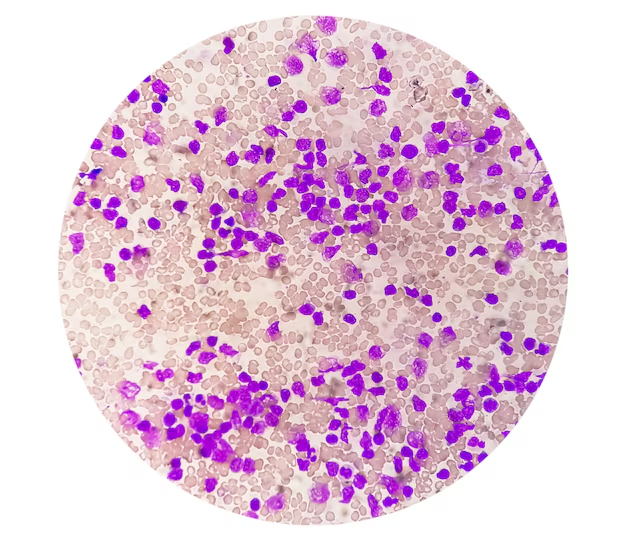
Doctors use CAR-T mainly in selected blood cancers, not all cancers. Current FDA-approved products cover several settings. For example, they include large B-cell lymphoma, follicular lymphoma, and mantle cell lymphoma. They also cover chronic lymphocytic leukemia or small lymphocytic lymphoma. Multiple myeloma and certain B-cell acute lymphoblastic leukemia settings are also included. Exact eligibility depends on the disease type and the specific CAR-T product’s label.
That means referral usually starts with a simple question: does the patient’s exact cancer type and treatment stage match a currently approved indication or a trial pathway? If not, the next step may be a clinical-trial review rather than standard approved care.
Medical Criteria
| Criteria | What the Team Reviews |
|---|---|
| Prior Treatment | Most approved CAR-T products require prior therapy. The number of prior lines depends on the disease and product. Some lymphoma labels require refractory disease or early relapse, while others require two or more prior lines. Myeloma and ALL also have specific requirements. |
| Disease Status | Teams review whether disease is relapsed, refractory, or rapidly progressing. They also assess whether disease is stable enough for manufacturing time and whether bridging therapy is needed. |
| Organ Function | Organ function is critical. Teams assess kidney, liver, heart, and lung function, blood counts, neurologic history, and overall performance status before clearance. |
Practical Criteria Caregiver
Many centers require a caregiver or strongly recommend one because patients can develop fever, confusion, weakness, or other urgent symptoms after infusion. MD Anderson’s patient guidance says the care team considers the patient’s living situation and that a caregiver is needed during the treatment period.
Travel
Travel and temporary local stay can be part of CAR-T logistics. MD Anderson states that patients and caregivers need to remain close to the center for the first 30 days after infusion. Exact rules vary by center and product, but travel planning is a real part of eligibility in practice.
Follow-Up
Follow-up is not optional. FDA labeling for approved CAR-T products includes monitoring after infusion, and centers need patients who can return quickly for urgent symptoms and attend repeated visits, labs, and safety checks.
Practical Criteria
Caregiver
Many centers require a caregiver or strongly recommend one because patients can develop fever, confusion, weakness, or other urgent symptoms after infusion. MD Anderson’s patient guidance says the care team considers the patient’s living situation and that a caregiver is needed during the treatment period.
Travel
Travel and temporary local stay can be part of CAR-T logistics. MD Anderson states that patients and caregivers need to remain close to the center for the first 30 days after infusion. Exact rules vary by center and product, but travel planning is a real part of eligibility in practice.
Follow-Up
Follow-up is not optional. FDA labeling for approved CAR-T products includes monitoring after infusion, and centers need patients who can return quickly for urgent symptoms and attend repeated visits, labs, and safety checks.
Tests Used in Evaluation
Evaluation often includes several steps. These steps involve blood tests, organ-function testing, and infection screening. Imaging or marrow studies may also be needed depending on the cancer. A disease-specific review confirms the subtype and current status. Centers also review prior pathology and treatment history. They check whether the patient has active issues that need stabilization before leukapheresis or infusion. This summary matches FDA safety labeling and major-center patient guidance. However, exact testing varies by disease and center.
Reasons Someone May Not Qualify Yet
A patient may not qualify yet for several reasons. These include uncontrolled infection or poor organ function. Rapidly worsening disease can also block eligibility. Inadequate performance status, missing records, or a mismatch with the approved product label are other factors. Sometimes the issue is not permanent. A person may become more eligible later. This can happen after infection treatment, bridge therapy, or better disease control. Completion of additional testing may also help.
Trial referral can also fail for practical reasons. Some studies have exclusion criteria related to organ function, prior therapies, active infection, or disease pace, and some patients may not be able to manage the travel and monitoring burden needed for cellular therapy

How to Prepare Records
Organize key records first. That is the fastest way. Most centers need diagnosis details. They also need pathology reports. Include recent scans. Add treatment history. Provide a current medication list. Show recent lab results. Note any infections or transfusions. Also note organ problems. This matches standard center workflows. Centers confirm subtype and prior lines. They also check current fitness.
What to upload first
Pathology or bone marrow report confirming the diagnosis
Most recent scans or disease assessment results
Complete treatment history in chronological order
Recent blood tests and chemistry panel
Current medication list
Hospital discharge summaries if there were recent infections or complications
FAQ
Who qualifies for CAR-T therapy?
People may qualify when their cancer type matches an approved CAR-T setting or a trial pathway, their prior treatment history fits the disease-specific rules, and their current medical condition is strong enough for treatment and monitoring. Final eligibility is determined by a treating center, not by one checklist alone.
Is there an age limit?
There is no single age limit for all CAR-T therapy. Some products have age-specific labels, such as Kymriah in B-cell precursor ALL for patients up to age 25, while many lymphoma and myeloma products are approved for adults. MD Anderson also notes that age alone does not automatically disqualify a patient.
Can infection delay CAR-T?
Yes. Active or severe infection can delay CAR-T because infection can make treatment less safe and is also a major post-treatment risk highlighted in FDA labeling.
Do I need a caregiver?
Often yes, or at least strong caregiver support is expected. Major centers may require or strongly expect a caregiver because patients can become sick quickly after infusion and may need urgent help or transport.
What tests are usually required?
Tests usually include blood work, organ-function review, infection screening, and disease-specific studies such as imaging, pathology review, or marrow assessment. The exact list depends on the cancer type and center workflow.
What records should I upload first?
Start with the pathology or marrow report, the latest scans or disease assessment, treatment history, recent labs, medication list, and any recent hospitalization records. These are the records most likely to help a center decide whether CAR-T review should move forward quickly.
Clinical Trials:
Medical Disclaimer & Source References
© BEIJING BIOTECH.
Clinical Sources: NCCN, ASCO, ACS, ESMO, CSCO, CACA, ChiCTR.
Clinical Trials: Trial eligibility depends on protocol criteria, disease status, prior therapy, organ function, timing, and location.